
Managing payroll is one of the most critical yet complex tasks businesses face, regardless of their size. The risk of human error, time-consuming manual processes, and continually shifting tax laws create ongoing challenges. With the advancements in payroll software, companies now have innovative tools to simplify payroll management, greatly enhance accuracy, and increase business efficiency.
Adopting a modern payroll platform does more than automate calculations—these solutions improve overarching business operations, provide robust security for sensitive data, and simplify compliance with ever-evolving regulatory requirements. For organizations seeking to optimize their resources, investing in payroll technology is quickly becoming a necessity rather than a luxury.
As workplaces become increasingly distributed and agile, particularly with the rise of remote and hybrid teams, payroll software provides the flexibility and scalability organizations need to stay competitive. Businesses can leverage cloud-based features and system integrations to future-proof their HR and finance processes, ensuring seamless adaptation to change.
By reducing manual interventions and administrative overhead, payroll solutions empower HR and finance teams to focus on strategic business development, employee engagement, and high-value activities that drive sustainable growth, rather than getting bogged down by repetitive tasks.
Table of Contents
Automating Payroll Processes
One of the primary benefits of payroll software is the ability to automate complex workflows that previously required hours of manual effort. The software handles calculations of employee wages, overtime, bonuses, benefits deductions, and tax withholdings, dramatically minimizing the risk of costly errors. Automated workflows not only reduce payroll processing time but also free up staff to focus on activities that contribute more directly to business objectives.
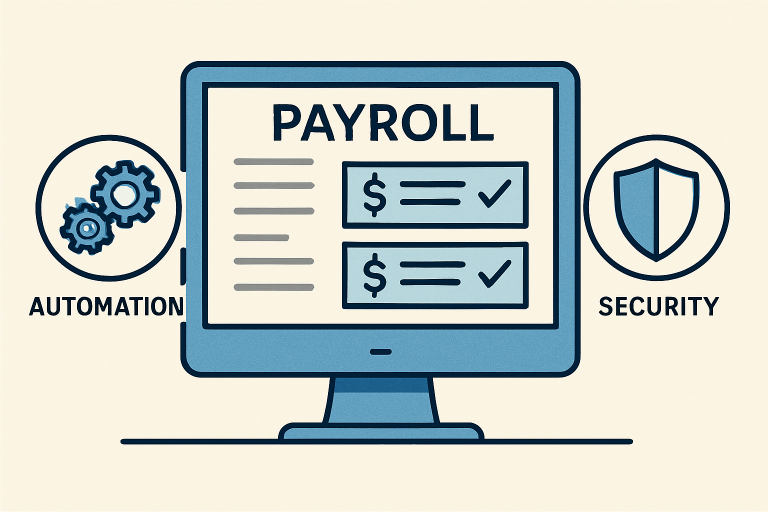
For businesses with hourly or remote employees, payroll automation streamlines the process of tracking hours worked, calculating shift differentials, and issuing accurate payments on schedule. Moreover, with built-in compliance checks, teams can operate with confidence, knowing that every paycheck adheres to the latest employment and tax standards.
Ensuring Compliance with Tax Regulations
Complying with ever-changing payroll taxes and labor laws is a key concern for any organization. Payroll software providers regularly update their platforms to reflect the most current local, state, and federal regulations, enabling businesses to maintain compliance and avoid substantial penalties. Not only does this reduce the administrative burden on HR and finance departments, but automated compliance features also provide peace of mind when filing required documentation and reports.
The best payroll systems automatically generate forms such as W-2s and 1099s, offer guided workflows for quarterly and year-end tax filings, and include audit trails for regulatory reviews. By centralizing and simplifying the compliance process, these tools reduce the chances of missed deadlines or tax miscalculations.
Integrating with Other Business Systems
Modern payroll platforms are designed to integrate seamlessly with a wide range of business tools, including accounting packages, HR management systems, and workforce time-tracking applications. These integrations enable business leaders to access consolidated reports and real-time data, ensuring both accuracy and integrity across financial and HR operations.
For companies juggling multiple systems or managing a distributed workforce, unified software architecture makes it easy to coordinate key processes such as onboarding, performance management, benefits enrollment, and end-of-year tax reconciliation. This holistic approach eliminates data silos, empowering data-driven decision-making at every business level. Additional insights on the importance of system integration can be found at Forbes.
Enhancing Data Security
Payroll data contains highly sensitive information, including social security numbers, banking details, and salary figures. To prevent unauthorized access, payroll solutions are equipped with advanced security protocols, including encryption, two-factor authentication, access controls, and regular security audits. By centralizing payroll management in a secure digital environment, businesses can meet or exceed industry data protection standards and ensure employee trust.
In an era of increasing cyber threats, business leaders cannot afford to compromise on the protection of payroll data. Choosing a reputable payroll software vendor can significantly strengthen security posture and simplify compliance with data privacy laws such as GDPR and CCPA. For more information about payroll data security essentials, visit SHRM.
Providing Employee Self-Service Portals
Leading payroll systems frequently feature user-friendly, mobile-optimized employee self-service portals that put control directly in the hands of staff. Through these portals, employees can quickly view and download pay stubs, retrieve historical tax documents, submit time-off requests, and update personal contact or banking details. This self-management not only streamlines routine payroll tasks but also minimizes errors and delays. By enabling employees to manage their payroll information independently, organizations reduce the administrative burden on HR teams, enhance operational efficiency, and foster greater employee satisfaction and engagement throughout the workplace.
Offering Scalability for Growing Businesses
As organizations scale, it becomes increasingly important to have a payroll system that can adapt to evolving needs. Scalable, cloud-based payroll solutions grow seamlessly alongside the business, efficiently supporting new employees, locations, and increasingly complex pay structures. Whether adding seasonal staff, expanding internationally, or handling acquisitions and mergers, cloud-based software eliminates the bottlenecks associated with legacy systems.
Reducing Costs and Improving Efficiency
Transitioning from traditional, paper-based payroll systems to automated digital platforms enables businesses to significantly reduce labor expenses and minimize errors that can lead to costly corrections. Automation streamlines payroll processing, ensuring accuracy, consistency, and compliance while saving valuable time. These efficiency gains translate into a strong return on investment, enabling companies to reallocate resources toward innovation, product enhancement, and superior customer service. By handling routine administrative tasks seamlessly, payroll software empowers organizations to focus on strategic initiatives, growth opportunities, and long-term business success rather than operational upkeep.
Conclusion
Adopting payroll software is a smart strategy for organizations seeking to streamline operations, improve accuracy, and protect confidential employee information. Modern solutions offer seamless integration with existing systems, scalable functionality to support business growth, and advanced security measures that protect against data breaches. Beyond simplifying routine payroll tasks, these tools help ensure compliance with ever-evolving regulations, reduce errors, and free up valuable time for strategic initiatives. By transforming payroll into an efficient, secure, and reliable process, businesses can focus on growth, productivity, and long-term success.