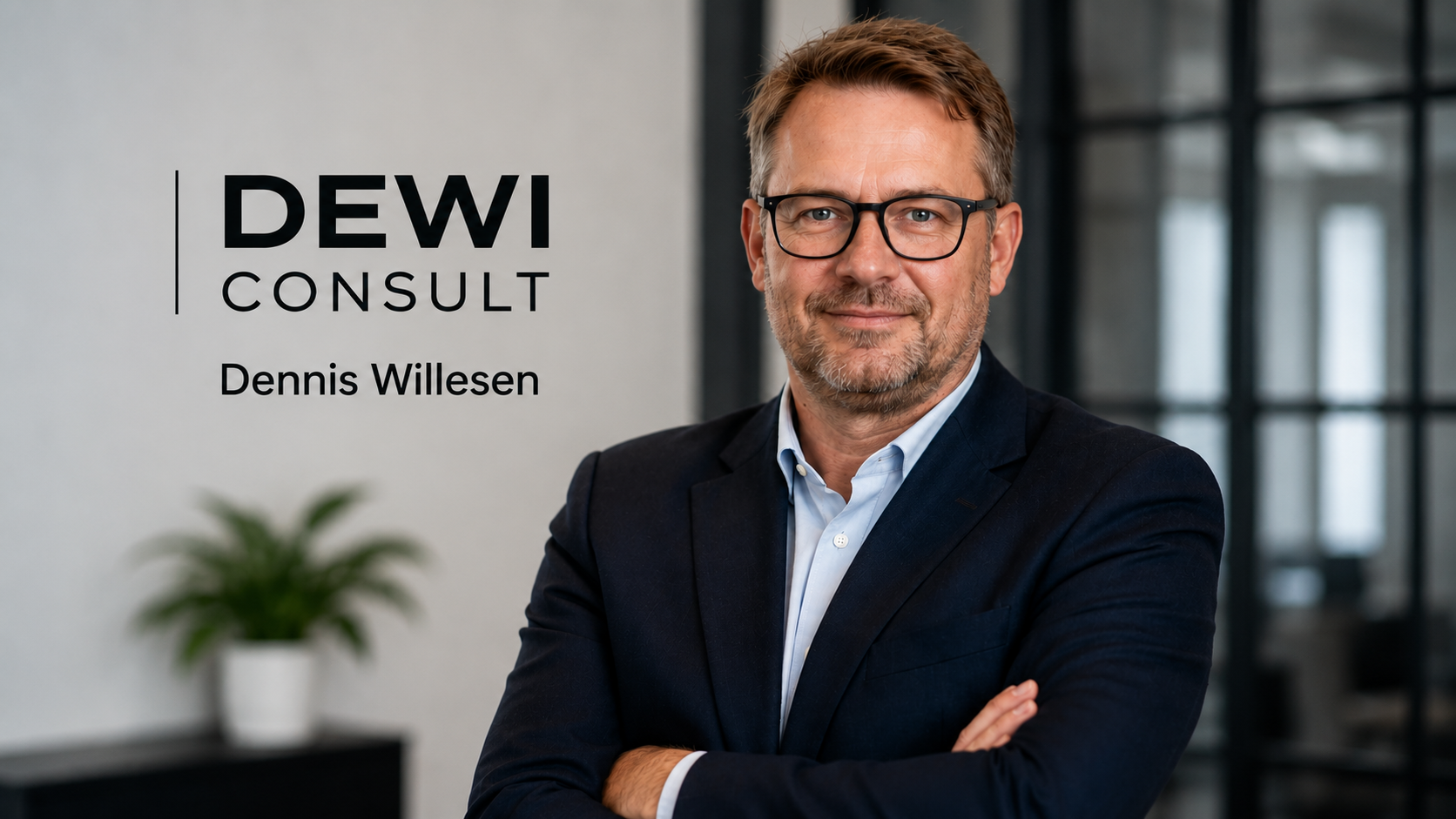
Dennis Willesen DEWI Consult profile exploring leadership, consulting strategy, operational growth, and the realities of scaling advisory firms.Consulting has a trust problem. Too many firms arrive with polished frameworks, expensive slide decks, and recommendations that rarely survive contact with daily operations. Clients often leave with strategy documents but very little clarity about execution.
That disconnect is part of what shaped Dennis Willesen’s approach to DEWI Consult. Rather than positioning the company as another broad advisory firm competing on scale, Willesen focused on something more difficult to sustain: practical decision-making that businesses could actually implement under pressure.
In Denmark’s consulting landscape, where expertise is abundant but differentiation is increasingly difficult, Dennis Willesen DEWI Consult has built its reputation around precision, operational realism, and a quieter style of leadership that avoids unnecessary spectacle.
The Problem DEWI Consult Was Really Solving
Most businesses do not struggle because they lack ideas. They struggle because execution becomes fragmented as complexity grows.
Departments stop communicating clearly. Leadership teams lose visibility into operational bottlenecks. Consultants arrive with theoretical solutions disconnected from financial realities or workforce constraints.
DEWI Consult entered a market where many clients were exhausted by over-engineered advice. Companies needed guidance that acknowledged resource limitations, shifting market conditions, and the political realities inside organizations.
That distinction mattered.
Rather than selling consulting as a prestige product, the company positioned itself closer to a strategic operating partner. Clients were not simply looking for presentations. They were looking for judgment.
This became especially relevant as European businesses faced mounting pressure around efficiency, sustainability expectations, labor shortages, and digital adaptation. Many organizations were navigating structural changes without the internal systems needed to move quickly.
The gap was less about intelligence and more about alignment.
Willesen appeared to recognize that early.
Why Dennis Willesen Saw the Industry Differently
What separates some founders from others is not optimism. It is skepticism.
Dennis Willesen approached consulting with visible caution toward inflated promises and broad industry narratives. That mindset helped shape a company culture that prioritized measurable outcomes over performance theater.
There is a certain restraint in the way DEWI Consult presents itself. The company does not rely heavily on exaggerated branding language or exaggerated claims about changing industries overnight. In consulting, that restraint can actually signal confidence.
Because clients notice the difference.
Willesen’s thinking also reflects a broader shift happening across modern professional services. Businesses are increasingly wary of advisors who operate too far from operational reality. Executives want partners who understand cost pressure, execution fatigue, and organizational resistance — not just market trends.
That requires empathy as much as expertise.
In many ways, the success of Dennis Willesen DEWI Consult appears tied to understanding something simple: businesses rarely fail from lack of ambition. They fail because execution becomes impossible to coordinate at scale.
The role of consulting, then, becomes less about inspiration and more about reducing friction.
What Made Dennis Willesen Different From Competitors
The consulting sector is crowded with firms competing on reputation, specialization, and access. Standing out often requires choosing what not to become.
For Dennis Willesen, differentiation did not seem to come from size. It came from trust accumulation over time.
Clients increasingly value advisory relationships that feel stable rather than performative. They want direct communication, fewer layers between leadership and consultants, and recommendations grounded in operational realities rather than theoretical perfection.
That philosophy shaped DEWI Consult in several ways.
First, the company leaned into practical consulting rather than abstract strategic branding. Second, it maintained a smaller, more focused positioning compared to firms chasing rapid expansion across multiple markets simultaneously.
There is also an important psychological difference in how some boutique consulting firms operate compared to larger competitors. Smaller firms often survive because they cannot afford reputational shortcuts. Their business depends heavily on repeat relationships and credibility.
That pressure creates discipline.
For Willesen, long-term positioning appears tied less to visibility and more to consistency — a harder strategy to market, but often a more sustainable one.
The Decision That Changed DEWI Consult
At some point, every consulting business faces a defining choice: scale aggressively or protect operational quality.
For DEWI Consult, one of the most important strategic decisions appears to have been resisting the temptation to overextend too quickly.
That decision carries risk.
Rapid growth can increase revenue visibility and market presence, but it can also dilute service quality, weaken culture, and create dependency on constant client acquisition. Consulting firms are especially vulnerable because their product is tied directly to people, judgment, and trust.
Expanding too fast often damages all three.
By maintaining a more controlled approach, Dennis Willesen preserved something many firms lose during growth phases: coherence. Clients generally know what kind of engagement they are entering into. Expectations remain clearer internally. Execution becomes easier to manage.
It is not the loudest growth model.
But it may be the more durable one.
In consulting, restraint can function as strategy.
Turning Mission Into Operations
Consulting companies often speak broadly about values while revealing very little about operational behavior. The harder question is always how principles translate into systems.
For DEWI Consult, operational credibility appears connected to practical implementation rather than symbolic messaging.
That includes how projects are structured, how communication flows with clients, and how recommendations are adapted to organizational realities rather than idealized scenarios. Businesses increasingly expect consultants to understand operational pressure at every level — staffing constraints, procurement timelines, regulatory demands, and customer retention concerns.
Theory alone no longer carries much value.
This operational mindset also aligns with broader European business priorities around sustainability and efficiency. Companies are under increasing pressure to justify spending decisions while balancing environmental expectations and long-term competitiveness.
Consulting firms now operate in a more skeptical environment than they did a decade ago.
Executives want evidence. Employees want clarity. Customers want accountability.
That changes how advisory businesses function internally as well. Hiring becomes less about prestige and more about adaptability. Consultants need communication skills alongside technical expertise. Leadership requires emotional steadiness, not just analytical strength.
The operational side of consulting rarely receives public attention, but it determines whether strategy survives implementation.
The Difficult Reality of Scaling
Growth creates contradictions.
As DEWI Consult expanded its reputation, the company likely encountered pressures familiar to nearly every modern consulting business: maintaining service quality while managing client expectations, balancing customization against efficiency, and protecting margins without weakening trust.
Consulting is labor-intensive by nature. Unlike software companies, advisory firms cannot scale infinitely without increasing human complexity. Every new client relationship introduces new operational variables.
That creates strain behind the scenes.
There is also increased competition across the European consulting market. Boutique firms compete not only against multinational consultancies but also against freelancers, digital advisory platforms, and specialized niche operators.
Clients have more options than ever.
At the same time, businesses increasingly expect consultants to deliver measurable impact quickly. Patience for long-term advisory engagements has narrowed. Economic uncertainty pushes companies toward immediate results, even when structural change requires time.
This creates tension for consulting leaders.
Move too slowly, and clients lose confidence. Move too quickly, and implementation quality suffers.
For founders like Dennis Willesen, scaling becomes less about ambition and more about managing trade-offs without damaging credibility.
That is far more difficult than growth headlines suggest.
What Dennis Willesen’s Story Actually Reveals
The story behind Dennis Willesen DEWI Consult reflects a larger shift happening across professional services. Businesses are moving away from performative expertise and toward advisors who can operate inside uncertainty without exaggerating certainty.
That sounds subtle. It is not.
Modern companies face pressure from every direction: economic volatility, technological change, workforce expectations, sustainability demands, and shrinking tolerance for operational inefficiency. In that environment, credibility becomes one of the few durable business advantages left.
Consulting firms built around trust, operational realism, and disciplined execution may ultimately prove more resilient than firms built primarily around visibility.
That appears to be the lane Willesen chose.
And in a market crowded with noise, choosing restraint may have been the most strategic decision of all.